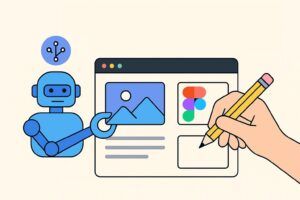
For years, web design has focused on one primary audience: people.
Designers think about how visitors scan a page, where they click, what catches their attention, and how easily they can move from one step to the next. Good UX has always been about making digital experiences intuitive, useful, and enjoyable.
But in 2026, websites have another increasingly important audience: AI.
AI-powered search engines, assistants, browsers, and agents are no longer simply indexing websites. They are reading pages, interpreting information, summarizing content, comparing products, and helping users make decisions. In some cases, they can even perform actions on a user’s behalf.
This creates a new challenge for web designers.
A website still needs to look great and provide an excellent experience for humans. But it also needs to communicate clearly with machines.
Welcome to the next stage of web design: designing for humans and AI at the same time.
From Search Engines to Answer Engines
Traditional SEO was largely built around search engines.
A user entered a query, received a list of links, and chose which website to visit. Businesses competed for visibility in those search results.
AI is changing that behavior.
Instead of presenting only a list of websites, AI-powered search experiences can generate direct answers by gathering and interpreting information from multiple sources.
Users can ask questions such as:
- Which software is best for my business?
- What is the difference between these two products?
- Which company offers this service?
- How much does it cost?
- What should I choose?
The AI may answer the question before the user ever reaches a website.
This means websites are increasingly becoming sources of information for AI systems, not only destinations for human visitors.
For designers, marketers, and businesses, that changes the rules.
Your Website Now Has Two Audiences
Human visitors and AI systems consume websites very differently.
People respond to visual hierarchy, imagery, typography, animation, storytelling, emotion, and brand personality.
AI systems are primarily interested in understanding information.
They need to identify:
- Who the company is
- What it offers
- Who its products or services are for
- How different pages and topics relate to each other
- What actions are available
- Which information is important
- Whether the content appears clear and trustworthy
The goal isn’t to choose between these audiences.
The challenge is to design an experience that works for both.
Clear Content Is Becoming a Design Requirement
Creative websites often use short, clever copy.
A homepage might say:
Make It Happen.
For a person viewing the page alongside a strong visual identity, supporting imagery, and navigation, the meaning may gradually become clear.
For an AI system, however, the statement provides almost no context.
What does the company actually do?
This doesn’t mean every headline needs to become long, boring, or stuffed with keywords.
Instead, designers need to think about context.
A creative headline can still work beautifully when it is supported by a clear description explaining what the company offers and who it serves.
The result can satisfy both audiences:
Make It Happen.
We design and develop digital products for technology companies, from UX strategy and interface design to scalable web development.
The first line creates personality.
The second creates clarity.
Good web design in the AI era needs both.
Information Architecture Matters More Than Ever
Information architecture has always been a fundamental part of UX.
Now it has another purpose.
A logical website structure helps both visitors and AI systems understand how information is organized.
Pages should have clear relationships. Navigation labels should make sense. Headings should describe the content underneath them. Important information shouldn’t be hidden behind vague labels or unnecessary interactions.
Think of the website as a structured conversation.
The homepage introduces the company.
Service pages explain individual capabilities.
Product pages provide specific information.
Case studies demonstrate experience.
About pages establish identity and credibility.
Articles provide deeper expertise.
When these pieces connect logically, the website becomes easier for people to navigate and easier for AI systems to interpret.
Visual Design Still Matters — Possibly More Than Before
If AI can summarize information without sending users to a website, does visual design become less important?
Quite the opposite.
As AI makes information easier to generate and distribute, differentiation becomes harder.
Websites filled with generic layouts, predictable components, and AI-generated imagery can quickly begin to look alike.
Strong visual identity becomes a competitive advantage.
Typography, art direction, illustration, photography, motion, color, and layout give a brand something AI-generated summaries cannot fully reproduce: a distinct experience.
The future isn’t about replacing visual creativity with machine-readable pages.
It is about combining expressive design with clear information.
A site can be visually bold while remaining understandable.
Design Systems Become Even More Valuable
Design systems already help teams maintain consistency across large digital products.
In an AI-driven web environment, their value increases.
Reusable components encourage predictable structures for content such as:
- Product information
- Features
- Benefits
- Pricing
- FAQs
- Testimonials
- Calls to action
- Case studies
Consistency helps users understand interfaces faster, but it also makes information more structured.
This doesn’t mean every page should look identical.
A strong design system creates rules that allow creativity without sacrificing clarity.
Accessibility and AI-Friendly Design Often Work Together
Interestingly, many principles that make websites more accessible also make them easier for machines to understand.
Semantic headings, descriptive links, meaningful alternative text, logical page structures, clear labels, and properly organized content all improve accessibility.
They also provide additional context about what a page contains.
This creates an important opportunity.
Accessibility, SEO, UX, and AI-readability shouldn’t be treated as four completely separate tasks added at the end of a project.
Increasingly, they are different outcomes of the same fundamental principle:
Design information clearly.
Don’t Hide Important Information Behind the Interface
Modern websites often use interactions to simplify complex pages.
Tabs, accordions, sliders, hover effects, pop-ups, and interactive experiences can all improve UX when used correctly.
But designers should be careful about hiding essential information simply to create a cleaner layout.
If something is fundamental to understanding a business, product, or service, it should be easy to discover.
Ask a simple question:
If someone only had a few seconds to understand this page, would the essential information be obvious?
That question works surprisingly well for both human visitors and AI systems.
Calls to Action Need Context Too
“Learn More” has been one of the most common buttons on the web for years.
But learn more about what?
Clear calls to action improve usability because they tell people exactly what will happen next.
For example:
Explore Our Services
is more informative than:
Learn More
And:
Download the Product Guide
is more useful than:
Click Here
Descriptive CTAs provide stronger context for visitors, accessibility tools, search engines, and AI systems.
Small copy decisions can therefore have a surprisingly large impact.
Performance Still Shapes the Experience
The arrival of AI doesn’t eliminate traditional web design fundamentals.
A beautiful website that loads slowly is still a poor experience.
Large videos, excessive animation, oversized images, and complicated scripts can make visually impressive websites frustrating to use, particularly on mobile devices or slower connections.
The challenge for designers is to create richness without unnecessary weight.
Motion should have a purpose.
Images should be optimized.
Interactions should support usability.
Visual effects should enhance the experience rather than become the experience.
Technology changes. Good UX principles remain remarkably consistent.
The Rise of Machine Experience
UX asks:
Can a person understand and use this website easily?
The emerging concept of machine experience adds another question:
Can a machine understand and interact with it easily?
This doesn’t mean designers suddenly need to start designing screens for robots.
It means the underlying structure of digital experiences is becoming more important.
Clear content, semantic structure, consistent components, descriptive labels, accessible interfaces, and logical user flows benefit both sides.
Machine experience is not replacing user experience.
It is expanding the definition of who — or what — may be interacting with the digital products we create.
What Designers Should Do Differently
Designing for AI doesn’t require abandoning everything we know about web design.
In fact, many of the best practices are familiar.
Start with a strong information hierarchy.
Make the purpose of every important page immediately understandable.
Use creative headlines, but support them with clear explanations.
Create navigation based on user needs rather than internal company terminology.
Use descriptive headings and calls to action.
Structure information consistently.
Design with accessibility in mind from the beginning.
Optimize performance.
And most importantly, don’t allow AI optimization to erase the personality of the brand.
The best websites will not be the ones designed exclusively for machines.
They will be the ones that machines can understand without making the experience feel machine-made.
The Future of Web Design Is Human — With a New Audience
AI is changing how websites are discovered, interpreted, and used.
But the fundamental purpose of design hasn’t changed.
Design helps people understand information, make decisions, complete tasks, and connect with brands.
Now, some of those interactions may be mediated by AI.
That means designers need to think beyond the screen and consider how their work communicates across different systems and experiences.
The websites that succeed in this new environment will combine three qualities:
Clarity. Structure. Personality.
Clarity helps people and machines understand.
Structure makes information easier to navigate and interpret.
Personality gives people a reason to remember the brand.
AI may be changing the way we experience the web, but good design remains fundamentally human.